Communication theory: MARGINALITY clothing brand.
List of contents
1. How communication theory works in the field of design 2. Presentation for a general audience 3. Presentation for a professional audience 4. Communication theory as basis for the presentations 5. List of literature and image sources
How communication theory works in the field of design
Communication theory is a prerequisite for designing, marketing, and operating brands successfully. Everything from designer tableware to fashion design needs a basis in communication theory in order to build a proper dialogue with buyers and clients. It is hard to imagine a situation in which a well-known design brand does not invest in promoting its products or does not take certain steps to organize its PR activities.
Communication theory is most clearly expressed, of course, in advertising design. Some advertisements can even be described as works of art. One of the most striking ads of the 21st century can be considered the PlayStation console campaign, which impresses with its creativity and unconventional design solutions. For example, one advertisement shows an eye in which geometric shapes of the console controller are reflected. If we analyze this ad from the perspective of communication theory, a question arises: «How can signs be used to show the attractiveness of the console and the fact that games are impossible to stop playing?» This is where Craig’s semiotic tradition comes into play, defining communication as the transmission of meaning through a system of signs. As a result, the viewer encounters screenshot signs of geometric capillaries and the slogan «Sleepless nights squared.» We decode these signs and create a new meaning that is not given directly but leads us to a conclusion through metaphor.
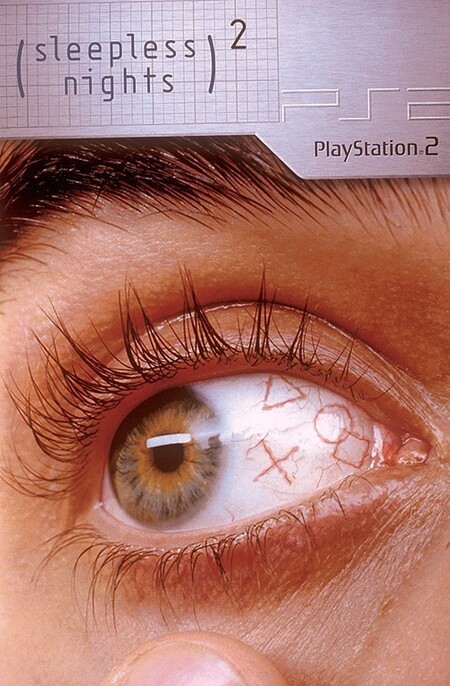

1.The Print Ad «SLEEPLESS NIGHTS» by TBWA\Paris for Sony Playstation 2, France, Jan 2001. 2.The Print Ad «REALISM» by TBWA\Paris for Sony Playstation 2, France, Jan 2001.
Another example of communication theory in design can be found in the theatrical fashion shows of designer Alexander McQueen. For instance, his 1998 show «Joan of Arc» appears as a complete narrative embodied in the design of the location, the clothing, and the stage action. Here it is important to mention Walter Fisher’s narrative paradigm, in which he argued that «we experience and comprehend life as a series of ongoing narratives, as conflicts, characters, beginnings, middles, and ends» [3, p. 24]. The show gradually develops the narrative of martyrdom, and in the final scene a model in a red dress appears before the audience surrounded by a ring of fire, creating an aggressive ending. Such shows represent a full narrative — a story, a form of storytelling. These techniques attract attention and are memorable because a complete narrative emerges in the viewers’ minds, which feels natural to our way of thinking according to the narrative paradigm.
In contemporary art, communication theory can be applied, for example, to Marina Abramović’s performance The Artist Is Present (2010). Abramović creates space for a silent dialogue with participant-viewers, who become immersed in interpersonal communication with the artist. Interpersonal communication is the process of message transaction (verbal and nonverbal) that occurs between two interdependent persons, normally within the context of their relationship, and that, as it evolves, helps them define and negotiate this relationship. In this performance, the artist pushes the boundaries between viewer and creator, establishing a personal form of communication that leads to different outcomes. This kind of «interaction» makes communication private and personal, elevating it to a level of intimacy.
Alexander McQueen Ready to Wear A/W, Paul Vicente, London, 1998
Thus, communication theory is applicable to various fields of design and art and is not limited to advertising imagery alone. Elements of this theory surround people everywhere, and it can even be described as one of the most practically oriented disciplines. What is particularly interesting is that examples from design and contemporary art expand the boundaries of the theory and open up new spaces for meaning. It is even possible to analyze art through the lens of communication theory, as demonstrated in the examples discussed above.
Presentation for a general audience
Who are we?
MARGINALITY is a brand that specializes in women’s clothing in an informal Gothic style. The aesthetics of our brand reflect the idea that the whole world is a large stage of a Gothic theatre. Just answer one question: who are you?
Who the brand is for:
- girls aged 16–30 who identify themselves with the Gothic subculture; - residents of the Russian Federation; - people who value the philosophy and meaning behind brands rather than dressing randomly or without thought.
In terms of communication theory course a Marginality brand goal is not just to attract an audience but also to keep them interested in our products. Therefore, brand communication with the audience takes into account their desires, needs, and context.
Brand message
Main slogan: «Who are you?»
Through this slogan, we: - Rely on the narrative paradigm — we invite the audience into a story of identity, inner conflict, and self-discovery; the brand is perceived not as a collection of garments, but as a living narrative. - Define core values: authenticity, depth, freedom of self-expression, and respect for individuality beyond social norms.
AI generated promo for MARGINALITY x БОГЕМА collaboration.
The MARGINALITY brand presentation is based on communication theories that emphasize an interactive, networked, and relationship-oriented approach.
Presentation for a professional audience
Brand platform and positioning
Category: clothing of the middle and high price segment
Positioning: ‘Marginality is a brand specializing in women’s clothing in an informal gothic style, fulfilling the audience’s desire for self-expression through appearance.’
From Craig’s perspective, we look at the brand through semiotic (the language of signs), sociocultural, rhetorical and digital rhetoric (the persuasiveness of messages across different channels).
Visual strategy (semiotics + visual rhetoric)
Color palette: - Ash gray — reflects balance and the transparency of our philosophy; the color of foundations; - Deep black — a color of depth that reflects the Gothic style.
Main visual approach:
- A combination of photography and expressive typography. This pairing reveals the style of our pieces and conveys the brand’s visual language
- Photography is processed using a halftone effect, which adds boldness and strengthens brand recognition
- Two typefaces are used in the typography: Coolvetica and Phorssa
We deliberately shape our communication through the three pillars of persuasion:
- Logos — rational meaning: quality of materials, precision of tailoring, durability, and thoughtful construction of each garment
- Ethos — trust in the brand: a clear Gothic identity, disciplined typography, conceptual consistency, and transparency in our visual and ideological language
- Pathos — emotion: a dark aesthetic narrative, the feeling of belonging to the Gothic world, and the idea that clothing is a form of self-expression rather than mere fashion.
In digital spaces such as our website and social media (Telegram channel), we build our communication through digital rhetoric — a continuation of classical rhetoric within the online environment, where visual impact, interactivity, and immediacy play a defining role.
Sociocultural and Critical Layer
Sociocultural Aspect:
The Marginality brand fills a subcultural niche, allowing women to find their ideal look and create a confident image within a specific aesthetic.
Critical Aspect:
We recognize the niche nature of our chosen clothing brand aesthetic and do not position ourselves as mass-market, which could impact the size of the audience interested in our product. That’s why we strive to build our customer base through friendly and active communication, events, and master classes.
Communication theory as basis for the presentations
Communication approach
Social media creates an extremely effective environment for branding. Their key features include interactivity, data storage, replicability, and mobility. All of this makes social media a convenient promotional tool and allows for reaching a wide audience. Interactivity expands the range of content forms suitable for promotion, while all information is stored online and accessible at any time. For these reasons, Telegram was chosen as the primary platform for promoting the gothic clothing brand Marginality. Telegram goes beyond traditional messaging, allowing for the creation of channels for information dissemination. The Marginality brand Telegram channel will be used to publish brand news, contact information, product catalogs, advertising campaigns, collaborations, and much more.
As additional platforms for enhancing our business, Marginality has a website and app with a catalog, contact information, and collaborations.
Audience Development
This will enable the formation of an online community: a database of people who will leave comments, share their looks, and participate in surveys. Self-disclosure plays a significant role here, allowing people to express their individuality — one of the most fundamental human aspirations. Special publications will invite subscribers to showcase looks featuring elements of Marginality, and participants will receive a discount as part of a reciprocity strategy. The behavior of users of the Marginality channel on Telegram could serve as a small example of technological determinism: subscribers, by posting photos of their looks, will return again and again thanks to the online platform. The strategy for maintaining audience engagement will be to create a space for dialogue. For this purpose, comments will be open and live broadcasts will be organized. Competitions for the best looks featuring items from the Marginality catalog will also play a key role. Recommendations and reviews are also important — for this purpose, special publications will be created asking for feedback. Fourth, educational content is also essential, and the brand will host online lectures on various aspects of Gothic fashion. It’s important to remember that an audience is formed when people encounter a common problem, recognize it, and organize to solve it. For Marginality, these are people seeking high-quality gothic clothing — primarily active audiences. Communication with them must be active and detailed: daily posts and video product announcements will be key. Since the brand is new, customer relationships are built on the principle of exchange, including discounts and free educational events to build loyalty.
Communication Strategies
Additional strategies include positivity — a friendly and supportive tone of communication, openness demonstrated by posting videos from the production process and personal moments of the brand. A network of partnerships is also important: Marginality will collaborate with jewelers and fashion designers working within the gothic subculture to expand contacts and increase awareness. Also, according to dialogic theory, several principles of online communication within the brand can be identified. First, there’s the dialogic loop —managers should answer customer questions as clearly as possible, and posts should include a statement that every request will be addressed. Next, the information’s usefulness is paramount, which is why key brand information will be collected in a separate message. At the same time, repeat visits will be ensured by a variety of content: themed photo shoots, news, production videos, product listings, ads, and customer images, while maintaining intuitive and easy navigation.
Segmentation of Messages by Audience
General audiences respond primarily to emotional and visual incentives. They use the peripheral information processing (ELM) pathway, based on atmosphere and expressiveness. According to Impression Management theory, people function socially by shaping the perception of their identity by others, like actors on a stage. Selective Exposure Theory, on the other hand, suggests that audiences seek out media that align with their beliefs (cognitive dissonance). Expert audiences, on the other hand, prefer structured and analytical information, which corresponds to the central ELM route, which is oriented toward logic and evidence. This helps a clothing brand develop its own unique identity without relying on mass-market products to find a loyal audience.
Description of the application of the generative model
Neural networks such as Sora, Recraft, and Artlist helped generate some of the visual content associated with the brand and the project.
ChatGPT was also used for high-quality prompts.
List of literature and image sources
Course «Communication Theory: Bridging Academia and Practice» [Electronic resource]. — Electronic text data. — 2025. Accessed 03.12.2025.
Irina Rogava’s personal HSE Design School project.
Fisher, W. R. (1987). Human communication as narration: Toward a philosophy of reason, value, and action. Columbia: University of South Carolina Press. URL: https://staibabussalamsula.ac.id/wp-content/uploads/2024/03/Human-Communication-as-Narration-Toward-a-Philosophy-of-Reason-Value-and-Action-Studies-in-Rhetoric-Communication-by-Walter-R.-Fisher-staibabussalamsula.ac_.id_.pdf Accessed 03.12.2025.
Griffin, E. A First Look at Communication Theory / E. Griffin. — New York: McGraw-Hill, 2012. Accessed 03.12.2025.
ChatGPT for a high-quality prompts.
Sora, Recraft, Artlist for images generation.
Irina Rogava’s personal HSE Design School project.
The Print Ad «SLEEPLESS NIGHTS» // AdsSpot — URL: https://fcdn.me/f24/95d/sony-playstation-2-sleepless-nights-f6d76b54ce92137f06063d1fd1.jpg (accessed: 13.12.2025).
The Print Ad «REALISM» // AdsSpot — URL: https://fcdn.me/de4/72b/sony-playstation-2-realism-0311355c569a70d50f125463ee.jpg (accessed: 13.12.2025).
Alexander McQueen. Savage Beauty in London // Meer — URL: https://media.meer.com/attachments/775e9e8910cc3b9a6f5be60812a909b9ff103f49/store/fill/1380/1035/54f626bfa377749205f659146d9e92266d4e2fc4154f5d99366fc76b5de2/Alexander-McQueen-Ready-to-Wear-A-slash-W-1998-Paul-Vicente-slash-AFP-slash-Alexander-McQueen.jpg (accessed: 13.12.2025).