
Communication theory: DEVOID
1. Introduction 2. Brand presentation for a general audience 3. Brand presentation for a professional audience 4. Explanation of how Сommunication Theory informed the project
Introduction
In contemporary culture, communication can no longer be understood as a simple transmission of information from a sender to a receiver. Especially in the fields of design and contemporary art, communication functions as a process of meaning-making rather than message delivery. Objects, spaces, interfaces, and visual systems do not merely inform; they shape perception, guide attention, and influence how individuals experience the world around them.
Design operates as a communicative environment. Furniture, packaging, everyday objects, and visual identities act as silent mediators between a person and their surroundings. Through form, material, scale, rhythm, and the presence or absence of detail, design communicates values, expectations, and patterns of behavior often without relying on explicit verbal language. In this sense, every designed object participates in communication, whether intentionally or not.
The contemporary communicative landscape is defined by overload. Individuals are constantly surrounded by competing messages, brands, interfaces, and choices. Visual space is saturated, attention is fragmented, and perception itself becomes a form of labor. Under these conditions, communication risks losing clarity, as messages begin to overlap, contradict one another, and dissolve into an indistinct background of noise.
Within communication theory, noise is understood as anything that interferes with the creation of meaning. In contemporary design culture, noise often takes the form of excessive visual coding: decoration, branding, stylistic markers, symbolic overstatement, and constant demands for attention. Rather than clarifying meaning, these elements compete with one another, reducing legibility and increasing cognitive fatigue.
In response to this condition, reduction emerges not merely as an aesthetic preference, but as a communicative strategy. By limiting the number of signs, designers can reduce noise and restore clarity. Minimalism, in this context, is not a style but an ethical position a conscious decision to respect the viewer’s limited cognitive and emotional resources. Reduction becomes a way to simplify interaction and make communication more readable and humane.
Absence itself can function as a form of communication. Silence, empty space, restraint, and pauses do not signal a lack of meaning; instead, they create conditions in which meaning can emerge through interpretation. In design and contemporary art, the refusal to over-communicate becomes a powerful gesture. By stepping back, design allows the viewer or user to step forward, completing the communicative act through their own perception and experience.
From this perspective, communication does not need to demand attention or impose interpretation. It can operate quietly, offering a framework rather than a directive. Design can choose not to shout, not to persuade aggressively, and not to overwhelm. Instead, it can create space for reflection, autonomy, and subjective meaning-making. This understanding of communication — shaped by context, noise, and interpretation forms the conceptual foundation for the project presented below.
Brand presentation for a general audience
DEVOID is a response to the contemporary condition of excess. In a world saturated with objects, brands, choices, and visual stimuli, everyday life increasingly requires constant decision-making and sustained attention. Even the simplest actions choosing a cup, a chair, a bottle of milk demand cognitive effort. DEVOID exists to remove this pressure. The brand creates objects that do not ask to be chosen and do not ask to be noticed. These are items without visual insistence, without decorative expression, without symbolic overload. They are designed to exist quietly within everyday life, performing their function without demanding interpretation or emotional response.
DEVOID business card design as part of the brand’s visual identity.
DEVOID products are intentionally stripped of decorative elements, branding gestures, textures, and unnecessary features. What remains is form, material, and use. This reduction is not an aesthetic provocation, but a practical decision aimed at restoring clarity and calm within the domestic environment. Simplicity, in this context, functions as relief. By reducing visual and functional complexity, DEVOID objects lower cognitive tension and create a sense of mental and spatial openness. They do not compete for attention, allowing the surrounding space and the person within it to breathe.
A domestic interior composed of DEVOID objects and furniture
The brand addresses people who experience fatigue from constant stimulation and choice. It is designed for those who seek quietness, neutrality, and the absence of pressure to perform identity through objects. DEVOID does not ask the user to express themselves. Instead, it removes the need for expression altogether. DEVOID operates across everyday categories: furniture, tableware, household objects, hygiene products, and pharmaceutical goods. Rather than functioning as separate product lines, these categories form a unified environment. Each object follows the same principle of reduction, neutrality, and restraint, creating a coherent and calm material ecosystem.
DEVOID tableware and decorative objects in a domestic setting.
Color is used not as decoration, but as a subtle organizational tool. White functions as the base state neutral, quiet, and unobtrusive. Slight tonal shifts differentiate categories: cooler hues for pharmaceutical products, softer green tones for herbal and tea items. These distinctions are informational rather than expressive, helping orientation without adding visual noise. At the center of the brand is the symbol of intentional absence. Referencing the concept of emptiness, the symbol does not prohibit or negate; instead, it marks a deliberate removal of excess. It represents the idea that meaning does not need to be imposed it can be left open, incomplete, and personal. DEVOID does not promise transformation, happiness, or self-optimization. It offers something more modest and more essential: a reduction of pressure. Through quiet objects and restrained communication, the brand aims to return a small but meaningful degree of control over attention and personal space to the individual.


DEVOID decorative objects emphasizing form, volume, and material neutrality.
Brand presentation for a professional audience
DEVOID is built on the principle of inverted marketing. Instead of competing for attention within an overloaded information environment, the brand deliberately withdraws from it. In a market where visibility is often equated with value, DEVOID adopts an opposite position: it does not amplify signals, but reduces them. Silence, restraint, and absence become active tools of communication rather than signs of passivity.
At the core of this approach lies an understanding of attention as a limited and fragile resource. Contemporary branding frequently treats attention as something to be captured, interrupted, or exploited. DEVOID treats attention as something to be protected. Every communicative decision visual, verbal, or spatial is evaluated not by its ability to attract, but by its ability to avoid unnecessary intrusion.
Storage furniture from the DEVOID collection.
This logic is implemented through a system of what can be described as «quiet signals.» The brand’s visual language relies on stillness, duration, and minimal change. Static, cinematic imagery replaces dynamic storytelling. Short, restrained video formats focus on light, surface, and tactility rather than narrative or persuasion. Communication is designed to slow perception down, not accelerate it.
Transparency replaces promotion as the primary communicative gesture. Instead of slogans or promises, DEVOID reveals processes: material selection, production techniques, manual labor, and time investment. Campaigns such as «The Price of One Item» translate cost into human-scale equivalents hours of work, origin of materials, duration of processes. This removes the aura of abstract pricing and reframes value as something concrete and understandable.
Beverage packaging designed with reduced visual language and functional labeling.
From a strategic perspective, DEVOID functions as an «accessible refuge». The brand does not rely on exclusivity or cultural capital to create distance. Instead, it democratizes the philosophy of quietness through clarity, consistency, and openness. Entry-level objects within the «Essentials» category provide a low-threshold introduction to the system, allowing trust to be built gradually through use rather than aspiration.
Audience growth follows a «magnetic field» model rather than an outreach model. DEVOID does not actively seek its audience; it creates a coherent aesthetic and conceptual field that attracts those already aligned with its values. This is supported through contextual placement in architectural, design, and cultural media, as well as physical presence in concept stores and spaces oriented toward slow consumption rather than high turnover.
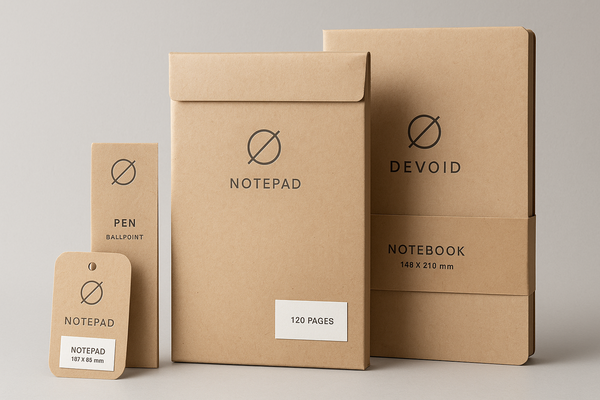

Packaging for large-scale furniture items from the DEVOID collection, designed as a modular system emphasizing neutral materials, reduced form, and clear structural labeling.
As a result, DEVOID operates not as a traditional lifestyle brand, but as a communicative infrastructure. Its objects do not perform identity, status, or aspiration. They recede into the background, allowing everyday life to unfold with less friction. For professionals, DEVOID can be read as an applied research project an exploration of how reduction, absence, and restraint can function as primary communicative strategies within contemporary design and branding.
Explanation of how Communication Theory informed the project
The development of DEVOID was grounded in communication theory not as a decorative reference, but as a structural tool. Rather than applying theory after the design was completed, communicative principles informed decisions at every stage from visual language to audience interaction and brand behavior. The project draws primarily on two of Robert T. Craig’s communication traditions: the socio-cultural tradition and the semiotic tradition.
Within the socio-cultural tradition, communication is understood as the process through which shared meanings, norms, and realities are produced and reproduced. From this perspective, brands are not neutral entities; they participate in shaping cultural expectations and patterns of behavior. DEVOID was conceived as a cultural response to the contemporary condition of overload a deliberate alternative to environments defined by excess, acceleration, and constant stimulation. By proposing absence, silence, and reduction as values, the brand positions itself not merely as a producer of objects, but as a contributor to a different cultural logic: one that prioritizes space, restraint, and intentionality.
The semiotic tradition focuses on how meaning is created through signs and symbols. In DEVOID, this tradition became a central design methodology. Absence itself functions as the primary signifier. Empty space, monochrome surfaces, reduced forms, and the avoidance of expressive branding are not neutral design choices; they operate as meaningful signs precisely because they contrast with the saturated visual language of the contemporary market. Meaning in DEVOID does not arise from what is added, but from what is removed. The lack of overt symbols invites interpretation rather than dictating it. Building upon this foundation, two specific communication theories were selected to translate these abstract principles into concrete brand behavior: Politeness Theory and Critical Theory as articulated by the Frankfurt School. Politeness Theory examines how communication manages social relationships by protecting an individual’s «face, ” understood as their public self-image and autonomy. The theory distinguishes between positive face the desire for recognition and alignment and negative face the desire to remain unimpeded and free from imposition. While originally formulated within linguistics, this framework proved highly applicable to design and branding.
For DEVOID, Politeness Theory informed the ethical stance of the brand’s communication. Contemporary branding frequently threatens the audience’s negative face through intrusive advertising, visual overload, and constant demands for attention. DEVOID adopts a strategy aligned with negative politeness by minimizing imposition. Generous negative space, restrained typography, minimal verbal messaging, and a calm visual rhythm signal respect for the audience’s autonomy. The brand does not interrupt; it waits.
At the same time, DEVOID addresses the positive face of its audience through alignment rather than flattery. By offering clarity, reduction, and restraint, the brand implicitly recognizes the user as someone capable of valuing absence and intentional simplicity. There is no attempt to persuade or elevate status. Instead, the brand communicates shared values, allowing identification to emerge naturally. In this way, Politeness Theory defines not only how DEVOID speaks, but how it behaves.
To provide the project with a broader critical dimension, the theoretical framework of the Frankfurt School was incorporated. Thinkers analyzed the «culture industry» as a system that standardizes experience, manufactures false needs, and transforms cultural production into a tool of passive consumption. Their critique remains relevant in contemporary consumer culture, where branding often prioritizes emotional manipulation, trend cycles, and planned obsolescence.
DEVOID positions itself in conscious opposition to this logic. The brand’s emphasis on durability, timeless form, and radical functional clarity functions as a form of resistance to accelerated consumption. Absence, within this framework, is not emptiness but an actively curated space one that is freed from the pressures of persuasion and spectacle. By refusing expressive excess, the brand becomes a critique of overproduction and overstimulation.
Critical Theory also informs DEVOID’s approach to experience. Rather than encouraging passive reception, the brand creates conditions for active engagement. Silence, empty space, and restrained form require the user’s participation to complete the communicative act. Meaning is not delivered; it is constructed. This aligns with the Frankfurt School’s call for cultural forms that resist commodified immediacy and instead foster reflection and awareness.
Together, these theories form a coherent framework. The socio-cultural and semiotic traditions establish the conceptual basis of absence as meaning. Politeness Theory defines the ethical and interpersonal dimension of the brand’s communication. Critical Theory provides ideological depth and positions the project within a broader critique of contemporary consumer culture. Combined, they transform DEVOID from a minimalist aesthetic into a communication-driven design system grounded in theory and cultural awareness.